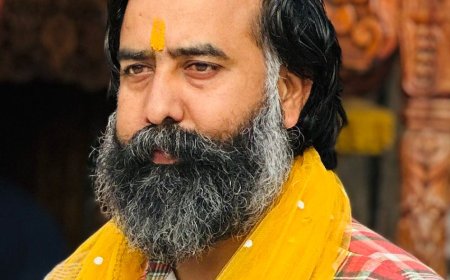
















Standards Define the Leader, Not the Spotlight:Hanshi Premjit Sen’s Global Martial Arts Philosophy
In an age where visibility is often mistaken for credibility, Hanshi Premjit Sen represents a contrasting philosophy—one where standards are established first, and recognition follows naturally. While many martial arts bodies pursue international acceptance through external validation, his work has drawn attention for a different reason: consistency, discipline, and institutional honesty. Rooted firmly in classical […] The post Standards Define the Leader, Not the Spotlight:Hanshi Premjit Sen’s Global Martial Arts Philosophy first appeared on HindustanMetro.com.


In an age where visibility is often mistaken for credibility, Hanshi Premjit Sen represents a contrasting philosophy—one where standards are established first, and recognition follows naturally. While many martial arts bodies pursue international acceptance through external validation, his work has drawn attention for a different reason: consistency, discipline, and institutional honesty.
Rooted firmly in classical tradition and guided by a long-term vision, Hanshi Premjit Sen has shaped the Global Seishinkai Shitoryu Karate Do Federation into a respected international institution. Today, organizations and serious practitioners from Africa, America, Europe, West Asia, and South Asia align with Seishinkai not through persuasion, but through trust built over time.
With more than twenty years of uninterrupted contribution to karate and allied martial disciplines, his journey reflects more than personal achievement—it reflects a sustained effort to position martial arts as a tool for nation-building, social discipline, and individual transformation.
Q1. Hanshi, many organizations actively seek global recognition. Your institution seems to attract it instead. How do you explain this approach?
Hanshi Premjit Sen:
Recognition has meaning only when it is earned through merit. From the outset, I avoided shortcuts—no rushed expansion, no borrowed names, no diluted standards. My focus remained on technical correctness, disciplined conduct, and transparent administration.
When an organization consistently practices these values, people notice. Institutions from Africa, America, Europe, West Asia, and South Asia approached us because they observed stability, seriousness, and respect for tradition. Trust cannot be marketed—it is built slowly, and that is what sustains an organization long-term.
Q2. As President of the Karate Do Association of Bengal, how have you connected martial arts with broader social responsibility?
Hanshi Premjit Sen:
Martial arts must serve society; otherwise, they lose relevance. Under my leadership, the Association expanded its role beyond competitions. We introduced structured training systems, certification pathways, and institutional coordination that directly support employment and professional development.
Today, many of our practitioners serve in the police, defense services, paramilitary forces, and government sectors. Karate instills discipline, accountability, and courage—qualities essential for public responsibility. Contributing to these national institutions is far more meaningful than medals alone.
Q3. Your long-standing work in women’s self-defense has drawn wide appreciation. What defines your philosophy in this area?
Hanshi Premjit Sen:
Women’s self-defense must be realistic and functional, not ceremonial. For over two decades, I have emphasized training that addresses real-life situations—mentally and physically.
Our programs focus on awareness, confidence, psychological strength, and practical response techniques. Thousands of women from different backgrounds have trained under our system. The intention is not to create aggression, but self-assurance and independence. A society where women feel secure is a society that progresses with confidence.
Q4. What core principles define the Global Seishinkai Shitoryu Karate Do Federation?
Hanshi Premjit Sen:
Seishinkai operates on clarity of purpose. We are guided by:
• Authentic traditional Shitoryu practice
• Transparent and ethical grading systems
• Instructor accountability
• Respect for lineage and discipline
• Absolute rejection of commercial shortcuts
We do not compromise standards for rapid growth. Expansion is meaningful only when values are preserved. This approach has ensured that the Global Seishinkai Shitoryu Karate Do Federation remains credible and respected across regions.
Q5. After decades of leadership, how do you personally define success?
Hanshi Premjit Sen:
Success is measured by impact, not position. If my students grow into disciplined individuals, responsible professionals, confident women, and principled instructors, then my work has purpose.
Champions may inspire momentarily, but character shapes society permanently. Martial arts must first build human values; achievement follows naturally.
A Purpose That Extends Beyond Competition
Hanshi Premjit Sen’s contribution extends far beyond training halls and tournament arenas. Through steady leadership, ethical discipline, and unwavering respect for tradition, he has repositioned martial arts as a social institution, not merely a sport.
Whether it is guiding youth toward meaningful careers, reinforcing national service structures, or strengthening women through authentic self-defense education, his work reflects a rare balance of technical mastery, moral clarity, and long-term vision.
In a time when recognition is often hurried and superficial, Hanshi Premjit Sen demonstrates that enduring respect is built patiently—through merit, discipline, and unwavering principles.
The post Standards Define the Leader, Not the Spotlight:Hanshi Premjit Sen’s Global Martial Arts Philosophy first appeared on HindustanMetro.com.
What's Your Reaction?